Bushfire - fact, fiction and other information relevant to living with bushfire in Australia.
Having maintained this blog since 2016, given the experiences since then, it's reasonable to conclude that the Australian and State governments and some local governments only reinforce bushfire mythology, neglect their prevention responsibilities, fail to implement a full PPRR risk management approach to mitigating bushfire, shortcomings proven in the devastation of Wye River–Separation Creek on Christmas Day 2015 and Yarloop, WA, on 7 January 2016. And elsewhere since then.
In the aftermath of the despicable act of terrorism at Bondi Beach on 14 December 2025, I heard numerous politicians mentioning words to the effect that the first responsility of a government was the safety of Australians. That means all Australians!
Here, I'm principally addressing bushfire — a failed emergency management methodology ruled by dogma.
Plate 1
Record of Ash Wednesday 1983 fires produced by the Herald and Weekly Times Limited shows what remained of the main street of Macedon after the impact of the 1983 fire.
Important to understand that I’m not being critical of CFA volunteers who commit themselves to support their own and other communities, more often than not at personal expense.
Plate 2
Let's start with fear.
Click on the image above created by Emergency Management Victoria. The running figure inside the evacuation triangle would instill fear in some unfamiliar with bushfire and possibly lead to poor decision-making leading to a deadly outcome — interesting to note that EMV is starting to discriminate between bushfire and grassfire. Maybe it's time to follow the USA and refer to any uncontrolled fire in the landscape as wildfire.
Then there is the "catastrophic fire danger rating" where that is applied. No doubt in some minds unfamiliar with wildfire, it's a short step from "extreme" to "catastrophic".
For some, the results of their exposure to wildfire are catastrophic. Why misrepresent an outcomes word to predict the outcome of an event yet to occur, is it adopted to frighten people?
Plate 3
Plate 4
Is leaving always the best option or does it lead to otherwise avoidable loss, including loss of human life?
Important to understand, who is responsible for that as a seemingly policy decision. Were they qualified to adopt that position? Was it adopted to serve the interests of emergency management protagonists rather than the broader community?
Let's consider the effect of leaving homes and businesses unattended. With no one there to combat ember attack, many structures are lost.
Plate 5
From the above paper:
Therefore, evaluating leaders based on a target—e.g., acres burned by prescribed fire— does not necessarily mean that the most important areas will be managed first.
This type of approach will require substantial change in selecting and evaluating leaders in land management. Generic evaluation criteria will need to be replaced with outcomes-based evaluation criteria—e.g., how did the acres treated contribute to achieving the management unit objectives associated with reducing the risk of high-severity fire? Appraisal of leaders against outcomes-based criteria will need to occur over a multi-year window to allow for the fact that prescribing fire and managing natural ignitions for resource benefits both require particular meteorological conditions. To effect such outcomes will necessitate organizational changes, from national offices down to local management units. If implemented, however, land management agencies will be better positioned to meet the challenges that are arising from rapid ecosystem change due to changing climate and disturbance regimes [my emphasis].
Plate 6
Lieutenant General Sir John Monash KCMG KCB VD, General Officer Commanding, Australian Corps seated in front of his staff. Photograph from Australian War Memorial, Canberra.
Plate 7
Then Lieutenant General Sir William Slim, General Officer Commanding 14th Army, India-Burma. Photograph from Imperial War Museum, London, England.
For those wondering why I included Monash and Slim in this posting. Though they had relatively humble beginnings both went on to overcome bias above them and achieve substantial, historic military victories. Both employed a combined operations approach, that is, infantry, armour, artillery and air to succeed.
Slim employed strategies and tactics that defeated the Japanese, obliterating them as a functioning force in some of the most difficult, indeed hostile landscape in the world. Slim's approach can be adapted to help minimise loss from bushfire. But it will require management by people able to implement fire management founded on prevention, preparedness, response and recovery, rather than just response and recovery.
As I complete this posting, I’m seeing advice to the community from EMV to “leave Woods Point and Gaffneys Creek; and “not safe to return to the area surrounding A1 Mine Settlement”.
I’m familiar with this area of Victoria having explored much of it by trail bike. A very remote part of Victoria populated by tough people who will have chosen to stay and defend their homes and businesses.
Why then urge them to leave? Surely EMV telling people to leave and stay away when EMV should be aware that the locals will be digging in and can supplement the CFA volunteers deployed there. Agency protection or more crudely expressed: corporate arse-covering?
I started preparing this posting shortly before Cyclone Alfred but put it on hold to see what learnings should ultimately be apparent and picked up by the emergency management agencies at all levels of government.
This blog posting is headed “Bushfire: Failure of governments” — I have assessed the performance of governments and their responsible agencies going back as far as the Ash Wednesday 1983 bushfires, particularly as they impacted Victoria, as I consider those fires to be the modern historical base of major fires in this State.
Included in the posting is a reference to the report of the Bushfire Review Committee. It’s an interest read, including much about warnings, evacuation and sheltering — and acknowledges that some people might choose to remain and defend their homes.
And what did we learn from the cyclone? Lots of instructions were being given by emergency management agencies on what to do i.e. others were considering the welfare of communities considered to be at risk.
In theory fine for a cyclone but a bushfire is different!
Below in this posting people in Pomonal have expressed a desire to remain with their homes, and what are the emergency management agencies doing to help them prepare and support them if they are again confronted with bushfire, other than urging them to flee?
Out of the cyclone response was this statement from Queensland Premier reported in The Australian, “David Crisafulli’s bid to replace Covid-era fear with facts in Cyclone Alfred response”, dated 10 March 2025:
Mr Crisafulli insisted that households be given accurate, timely information and, wherever possible, be allowed to make their own decisions on what to do.
The messaging had to be precise and locally focused, reflecting Mr Crisafulli’s nuanced communications strategy during the cyclone emergency.
His crisp, businesslike manner was new to Queenslanders: less of the emotive language and hand-holding that past Labor premiers Anna Bligh and Annastacia Palaszczuk had deployed, more -emphasis on imparting the nuts and bolts information people needed to know about the events unfolding around them.
On Sunday, the LNP man donned a suit and tie to deliver televised updates on the unfolding disaster.
“Instead of a top-down ¬approach of ordering people what to do, this has been about providing information from the bottom up, addressing challenges with the agencies and councils, and providing clear and detailed local messaging,” one senior government source said.
One example, the AFL was seeking advice from the Queensland Government on whether or not to play football in Brisbane on the Saturday, Crisafulli’s response was here are the facts, AFL, and you make the decision.
It's now approximately 11 weeks on from the 42nd anniversary of the 16 February (Ash Wednesday) 1983 bushfires in Victoria and South Australia and its worth looking back.
Plate 1
Record of Ash Wednesday 1983 fires produced by the Herald and Weekly Times Limited shows what remained of the main street of Macedon after the impact of the 1983 fire.
By this time Victoria was well into recording the details of its losses, including the 47 human lives taken by the fires. Reasonable to expect that the government's soon to be established Bushfire Review Committee members were assembling their thoughts and modus operandi – S.I.Miller, Chair; AVM W.Carter, Deputy Chairman and R.G.Stephens, Member.
And, what have we learned from the fires, in my opinion little or nothing if we consider the two recent Grampians fires.
"There's a lot of stuff that's been suppressed over the past year, so that when we're back into the fire situation again it can be quite traumatic for people who lost properties or suffered through the Pomonal fires."
It's a stark contrast to 12 months ago when a dry lightning strike started a fire that ripped through the town, destroying 45 homes.
This summer fire again threatened the town, reigniting the fears and realities that come with living in the shadow of a national park.
Some residents have left, but many have stayed and are keen to rebuild their homes and lives.
They say the community is all the stronger for having survived two bushfires in 10 months.
To accommodate these people the emergency management agencies at all levels must move away from the current approach of frightening people from their homes to supporting them.
Plate 2
From a story in The Australian "Disasters 'More intense, More Frequent'"
dated 29 December 2024
"We live in a country which has harsh conditions," he [Mr Albanese] said.
"It has always had, it has always had these extreme weather events, but the truth is they are becoming more frequent and more intense and that has been something that I have (seen) as Prime Minister for 2½ years and I have been to natural disasters and extreme weather events in every single state and territory of the country and that says something about this frequency."
NATURAL DISASTER
Let’s look at natural disasters as referred to by Mr Albanese.
What is a natural disaster?
There are many definitions of natural disasters and some get into natural hazards. The following from Wikipedia is consistent with PM Albanese’s reference to natural disasters:
A natural disaster is the very harmful impact on a society or community brought by natural phenomenon or hazard. Some examples of natural hazards include avalanches, droughts, earthquakes, floods, heat waves, landslides - including submarine landslides, tropical cyclones, volcanic activity and wildfires.
Let’s deal with bushfire (or wildfire). Physics and experience tells us that the harmful effect of bushfire can be mitigated by managing the fuel e.g. fuel reduction burning involving otherwise unmanageable broad areas of forest.
PM Albanese and his sidekick Premier Allan have been handwringers for the cameras in the aftermath at fire events such as Pomonal and in Albanese’s case the recent Queensland floods, but consistently failed to reduce the impact of the problem. Consequently, they are both frauds when it involves mitigating the effects of bushfire and other forms of emergency.
We Australians deserve better than Albanese and Allan controlling emergency management!
Important to consider the one-size-fits-all leave early policy and ask the question; how many homes and businesses have been lost as a result and can it be improved? Indeed, what is the basis of the advice?
In recent history there are examples of individuals who’ve stayed behind to save their own home and those of several of their neighbours. Here's recent example from Los Angeles:
How one man defied evacuation orders to stay and save his home
He said he wished the Los Angeles Fire Department put in the same effort as he did.
"When I was out here, hosing the house down and getting ready and when the houses started to burn, I didn't see one single fire truck out here at all. Zero.
"If they had had some fire trucks and just put a squirt here, a squirt there and kept an eye on things, all these houses would be here now. I'm telling you right now. I saw it with my own eyeballs. All these houses.
"The houses behind me they're all gone. They started with one little spark, one little small fire. They just squirted those out, had a few people out there, they'd all be here now."
Black Thursday, February 6th, 1851, by William Strutt. On display at the State Library of Victoria's Pictures collection.
AUSTRALIA
Within Australia and certainly in Victoria there is anecdotal and other evidence of people staying and succeeding in protecting their homes.
Deplorable that the desire of people to protect their homes is not really acknowledged by the fire services and people supported accordingly rather than scaring them into leaving — some will want to stay and defend their homes.
“But in many minds, staying to defend your house is the Australian test of grit: it’s proof that you deserve to be living in the bush in the first place.”
From the book "the arsonist A Mind on Fire, by Chloe Hooper, Penguin Random House Australia Pty Ltd, 2018."
Whatever happened to continual improvement that in modern history should have at least been benchmarked on the recommendations in the 2009 Victorian Bushfires Royal Commission, which included fuel management!
While finalising this posting I became aware that the evacuation of Dimboola was being urged. Reasonable to ask, had those responsible for urging the evacuation ever been to Dimboola and assessed its vulnerability to bushfire? I am reminded of the Maui Wildfires – December 23, 2024 when considering the loss potential at Dimboola.
Finally, Plate 2 (above) would be a fair representation of a panic-stricken populace fleeing a bushfire — the emergency management agencies and the media do nothing to dispel the fear.
It's happening again! In more recent times, first, Wye River-Separation Creek in 2015; Mallacoota in 2019-20; and now the Grampians — both Mallacoota and Grampians fires causing such havoc, cost and loss were burning in National Parks.
People being virtually ordered from their homes and businesses in a broad-brush approach with seemingly little or no consideration of the actual vulnerability of those structures.
But first, Western Victoria, another example of how Victorians rely on the indefatigable CFA volunteers, with due respect to all the others involved in or supporting the firefight.
Plate 1
A firefighter walks past a home burning from the Mountain Fire in Camarillo, California. Wildfires are contributing to increasing insurance costs. (David McNew/Getty Images)
You might wonder why my interest in the Mountain Fire in Camarillo, California (Plate 1) but here's a story in The Washington Post 16 December 2024 about obtaining insurance for a family home that includes wildfire (bushfire in Australia if you prefer), certainly relevant in Australia. An extract from the story:
The small mountain town, a short drive from Lake Tahoe, offered the former preschool teacher and her husband, a carpenter, a shot at becoming middle class by escaping crushing housing costs near Santa Cruz, California.
“We moved up here for a better life,” she said in a phone interview. “For two or three years, we got that taste.”
The small mountain town, a short drive from Lake Tahoe, offered the former preschool teacher and her husband, a carpenter, a shot at becoming middle class by escaping crushing housing costs near Santa Cruz, California.
“We moved up here for a better life,” she said in a phone interview. “For two or three years, we got that taste.”
Then the insurance bills came. In 2017, the couple paid $1,100 to insure their small cabin. But since then, nine of California’s 10 largest wildfires have erupted, sending the insurance market into turmoil. Three insurers have dropped her in three years. This year, a basic policy from the public FAIR plan, the state-run insurer of last resort, and supplemental private insurance will cost Temple $6,000. It’s likely to rise again. “Now we’re back to watching each paycheck,” she said, “and budgeting for everything.”
Temple is among the many Americans watching their hold on homeownership slip away as insurance costs balloon beyond their ability to pay. “This is our first house. I don’t want to leave,” said Temple, struggling to keep her composure. “I try not to look too far into the future. I get scared.”
Difficulties in obtaining insurance associated with bushfire risk is also being experienced in Australia. From Bellrock:
Policyholders who have property located in ‘bushfire prone areas’ (usually classified by local council), are likely to experience insurers having less appetite to insure their property. This may mean that insurers who are satisfied with the business operations, construction and risk management controls of the premises will be unwilling to deploy their capacity if the area is deemed to be a high-risk bushfire zone. Other insurers may look to use alternative strategies in order to increase the acceptability of risk, most commonly by way of increasing premiums or deductibles. This puts policyholders into a difficult position as they are unable to manage this exposure in any meaningful way. Installation of fire breaks and maintaining clearance will assist to a degree, however, wildfires are often unpredictable in nature and their severity is very dependent on prevailing weather conditions.
and
If underwriting losses exceed returns, insurers will cease to provide insurance cover at an affordable price. We have already witnessed this in parts of the world such as the USA where cover for bushfire in parts of California is unavailable except via a state scheme known as The California Fair Access to Insurance Requirements (FAIR). That scheme provides very basic last resort cover at a very high price point. Government in Australia, at all levels, is hesitant to provide any such scheme as they themselves are already carrying significant exposure on their own property portfolio.
Important to consider the one-size-fits-all leave early policy and ask the question; how many homes and businesses have been otherwise avoidably lost as a result and can it be improved? Indeed, what is the basis of the advice?
Then there’s the posting of warnings. It must have been confusing, indeed frightening for some as the plethora of warnings and areas they applied to were issued over days. Again, can it be improved?
Responsibility and accountability
Extract from an ABC story:
Victorian Premier Jacinta Allan said she was focused on supporting emergency services and communities affected by the bushfires, rather than division within the Liberal Party room.
"We're two days after Christmas and we see the Liberal Party focused on their disunity and lack of trust in each other — that's for them," she told 3AW. "I'm focused on our Victorians who are under fire threat and supporting our emergency services.
"I cannot emphasise enough how what is going on in the Liberal Party party room, two days after Christmas while parts of the state are under fire risk, is very much a matter for them."
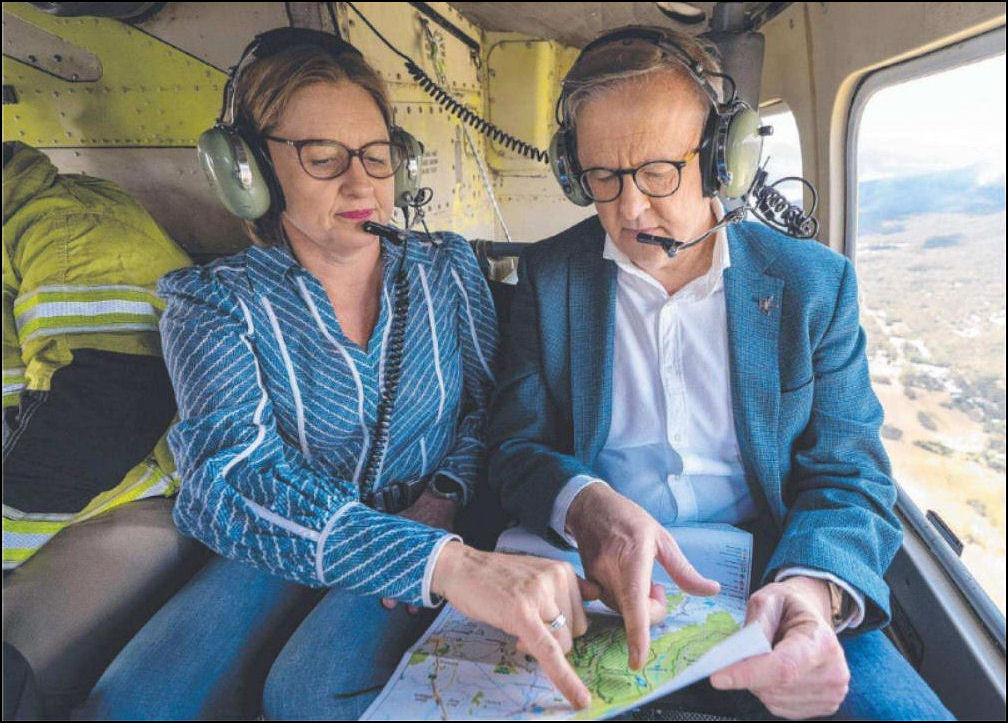
Prime Minster Anthony Albanese and Victorian Premier Jacinta Allan announce 13 weeks pay for those in need. Picture: NewsWire / David Crosling ... From a story "Disasters 'More Intense, More Frequent'", The Australian, 30 December 2024.
Part of the 'smokescreen'.
Extract from an ABC storey:
'Habitat will be lost, plants will die'
Deakin University associate professor John White has studied how species and ecosystems respond to external threats such as fire and climate change, particularly in the Grampians, since 2008.
Dr White expected the devastation caused by the fire to be felt for many years.
"This is about the fourth large fire in the Grampians in the past 20 years, which is a lot more than normal," he said.
Premier Allan, need I remind you that there is a Minister in your government responsible for as near as practicable risk-free management of the Grampians National Park, which must include protection of the adjoining landholders? Looks like failure to me and no doubt many others.
Whatever happened to continiual improvement that in modern history should have been benchmarked on the recommendations in the 2009 Victorian Bushfires Royal Commission, which included fuel management!
“But in many minds, staying to defend your house is the Australian test of grit: it’s proof that you deserve to be living in the bush in the first place.”
Dwarfed by the 2009 Kilmore East and Murrindindi wildfires was a relatively smaller but horrifically deadly fire that occurred at Churchill in the Latrobe Valley, Victoria. Deadly in that this fire took 11 lives.
I recently came across another perspective of the fire in the form of a book: the arsonist A Mind on Fire, by Chloe Hooper, Penguin Random House Australia Pty Ltd, 2018.
I did some authenticity checking before committing to review this book and am satisfied that it’s genuinely heartfelt: a couple of relevant review comments by others:
‘A brilliant vignette in which one appalling incident illuminates a saga of social breakdown.’ Sarah Wheeler, The Times, and from the back cover
‘A gripping heart-stopping piece of true crime reportage … Deserves the widest possible audience.’ Brian Schofield, Sunday Times (UK)
Of course there are also reviews by Australians, but I chose these two given our somewhat hardened attitude to wildfire, or bushfire if you prefer, quickly forgetting and moving on to await the next occurrence having learned little.
The book basically addresses three issues: the investigating detectives; the lawyers; and the courtroom.
The author gets close to the investigating detectives assisted by a fire expert who were able to, using the effect of the fire on vegetation, determine the point of origin of the fire and its subsequent spread before the wind. Anyone looking for authoritative information on wildfire investigation would find this instructive.
The author also goes into some detail about the investigation leading to the arrest of the individual eventually convicted for lighting the two fires, including the importance of observations by locals who ultimately help lead investigating police to that individual.
Also in the book are accounts of personal experiences of involvement in the fire, those who were caught in the fire and some who drove into the fire to help family and friends. Some of these people would lose their lives. I found these accounts very moving and thought-provoking.
From a family preparing for the arrival of the fire:
“Throughout the afternoon, the family listen to the radio and check the websites of the Country Fire Authoity and the Department of Sustainability and Environment [now DEECA]. There are now blazes all around the state, although no specific warnings are issued for their area.”
Regardless of warnings and evacuation demands/advice issued by the emergency management agencies across Australia, some will still wish to remain with their homes.
Which brings me back to the quote at the beginning of this posting:
“But in many minds, staying to defend your house is the Australian test of grit: it’s proof that you deserve to be living in the bush in the first place.”
Causes me to wonder, are the responsible agencies ‘washing their hands’ of the community with their ‘everybody out’ approach? A long road back to restoring confidence in personal wildfire survival in a community continually subjected to what I consider to be evacuation scare tactics.
Reasonable to ask, are those agencies advocating a one-size-fits-all evacuation approach meeting the needs of those who choose to stay, in other words are those agencies fit for purpose in meeting the wildfire survival needs of the whole community?
I recommend this informative and easy to read book on a very complicated subject that should be available to borrow from the local library. Knowledge that could be life saving if it provokes curiosity in the reader.
While keeping in touch with developments in the Israel-Gaza military conflict and aftermath of the Hamas raid into Southern Israel I heard a relatively brief opinion of “terror”.
I searched the web for terror-related information and finally settled on a definition in the Macquarie Dictionary, Fifth Edition:
1. intense, sharp, overpowering fear: to be frantic with terror.
2. a feeling, instance or cause of intense fear.
Started me thinking about meaning and forms of terror and how it may be created and used to advantage.
Within the definition there is also a reference to a political group using violence to maintain or achieve supremacy. A recent example was the activities of Hamas on the ground inside Southern Israel.
The definition of terror-stricken is relevant:
- smitten with terror; terrified
No doubt many will have seen media coverage of people attending the music festival in Southern Israel running to escape the Hamas shooters.
As I write I'm hearing of a severe bushfire situation in Southern Queensland while the attention of our media is distracted by broader regional and economic situations affecting Australia.
This causes me to think about Australians in areas threatened by bushfire being urged to leave their homes and businesses — some Australian states, but thankfully not Victoria, have mandatory evacuation legislation.
For several years, emergency management agencies have urging people to leave for an ostensibly safer place when bushfire reaches a certain level of threat. But, are we told why?
Urged or mandatory evacuations can create risk situations where unattended properties are lost to bushfire, why, because most building fire loss is due to ember or firebrand attack!
How then is a decision made to advise voluntary or mandatory evacuation?
At one level of the Australian Fire Danger Rating System (AFDRS) people are advised to leave, then only a few minutes later informed that it’s too late to leave and to shelter in place. This must be confusing, leading to unnecessary fear in some. How do those who wish to leave to now learn that it’s too late to leave cope with this? It must be unnerving and potentially result in injury or death for some unprepared individual.
Plate 1
From an ABC story "Sixteen homes lost in Tara as Queensland bushfire emergency continues", by Scout Wallen and Laura Cocks, 26 October 2023
The AFDRS classification “catastrophic” is a prediction of a catastrophic fire, an outcome that may never occur. Serves only to further frighten, even panic some people.
Why then did Australasian Fire Authorities Council (AFAC) decide on “catastrophic”, by definition an outcome rather than a warning such as Code Red that had previously applied in Victoria and why did emergency management decision makers in Victoria abandon Code Red?
Plate 2
Did those who settled on “catastrophic” do so through lack of knowledge of the English language or was intended to avoid agency or individual responsibility for loss by outsourcing the decision to the individual?
Was there any realisation that "catastrophic" as a warning or generally in the narrative was bound to add to the level of fear of fire in the broader community?
Referring again to sensationalism in the media, Vladimir Lenin, former Chairman of the Council of People's Commissars of the Soviet Union, was well aware that use of the media was critical to him in seeking to control Russia: Control the media, control the people.
Plate 3
Painting of Lenin by Isaak Brodsky (Public Domain).
Do the emergency management agencies see the sensationalist media coverage of bushfire as assisting them in seeking to control rather than support the community to withstand bushfire and minimise loss?
How does AFAC and for that matter the NEMA see their roles in the community, working in partnership with the broader community to withstand bushfire or frightening it into running?
And, what of EMA in Victoria? It’s performance to date has been miserable e.g. Loch Sport, what was learned from the Wye River and Mallacoota experiences that I would argue saw the involved communities pushed aside, leaving town protection to fire brigade units, some of which travelled long long distances involving several hours.
"Queensland Premier Annastacia Palaszczuk praised the collaborative efforts of firefighters from two states for saving the community, after winds blew the bushfire to the edges of the town late yesterday afternoon."
Has it ever occurred to Premier Palaszczuk to question Queenslanders responsible for emergency management how fires reached this stage, again?
Once again, Australia is indebted to legions of volunteer firefighters who leave the comfort and safety of home to go chase and round up the rampaging red steer.
As always, I would welcome your feedback.
Note that the coloured text indicates links to further information to be clicked on.
A record of the Ash Wednesday 1983 fires produced by the Herald and Weekly Times Limited shows what remained of the main street of Macedon after the impact of the 1983 fire.
Today, the 40th Anniversary of the Ash Wednesday 1983 bushfires that took so many lives in Victoria and South Australia.
Some salient recollections
On that fateful day my involvement as CFA Regional Officer in Charge Region 14 commenced at 6.00 am with a telephone call from the Group Officer, Mount Macedon Group, informing me that there was a fire in unburnt bush at Cherokee in the Macedon Ranges and that it was "burning well".
At approximately 11.30 am I was informed that the Cherokee fire was "acting up" and that an additional six tankers had been despatched and that the Forests Commission were involved at the fire. By this time the day was warming up, with an already strong north wind.
At approximately 2.30 pm I received advice from the Forests Commission, Macedon office, that there was a fire at Trentham East and shortly after from the Daylesford office that the fire was heading south into the bush. The rest is history.
Responding to the experience of the Ash Wednesday bushfires in Victoria.
In the aftermath of the 1983 fires the CFA Board finally decided to address a statutory responsibility in the Country Fire Authority Act since its inception thirty-eight years ago — finally, an officer was appointed to establish a Fire Prevention Department. In those few years following the 1983 fires I consider CFA reached its short-lived zenith as it pushed Prevention at state and local government.
In the few years following Ash Wednesday considerable emphasis was placed on Prevention, but there was a lot of catching-up required and Suppression was always dominant when it came to the allocation of resources. For those holding the purse strings, there is much more kudos associated with the allocation of firefighting vehicles.
And what did we learn from Ash Wednesday 1983?
As a learning experiences Ash Wednesday and the major fires that have followed, and as recent as the Mallacoota fire of December 2019, Victoria continues to experience bushfire losses that indicate to me that little was learned from those fires.
Bushfire loss could be significantly reduced with better community understanding of bushfire and how to survive — it should be well understood in the fire agencies that the major cause of housing loss is ember or firebrand attack.
Some will remember a fire that occurred in the Lancefield area of Victoria in early October 2015 that spread from an earlier DELWP fuel reduction burn-off. Premier Andrews was quick for the government to accept responsibility for the fire and promised compensation for people who could have done more to protect their assets.
Here is one example of a house clearly lost from the effect of fire spreading from ember or firebrand attack:
Plate 2
Plate 3
Plate 4
Plate 5
Of the photographs Plate 2 is a dwelling on the north side of Three Chain Road, Lancefield prior to the fire; Plate 3 and 4 are the remains of same dwelling after the fire — look through the trees to see the green beyond and the only shrubs burnt were abutting the dwelling; and Plate 5 was typical of the adjoining the forest that showed no sign of crown fire.
With only small patches of dead grass and fallen leaves beneath trees burning, it was obvious that unprepared buildings and rubbish down the back yard succumbed to ember or firebrand attack.
No doubt a blanket one-size-all-approach to urging people to leave their homes adds to housing loss.
Lancefield, a fire that largely due to the fickleness of the weather escaped from a fuel reduction burn a few days after it was lit.
And what of homeland defence?
From The Australian today, 16 February 2023:
"[Prime Minister] Anthony Albanese has been handed a blue print to prepare Australia for a potential war with China, recommending a rapid boost to long-range strike capabilities, the urgent acquisition of killer drones, and a major increase in the nation's naval firepower".
It's not all that long ago that the Australian Defence Force needed to come to the rescue of people in Mallacoota in the aftermath of a fire that roared out of the bush and trapped holiday makers and residents in the town. Necessary due to the failure of a government agency managing land it was responsible for so that it did not endanger people and their assets.
With our military capability to be strengthened to keep an aggressor from our shores, what about our vulnerability onshore? Poorly managed tracts of public land, such as that which overwhelmed Mallacoota, must be assessed as to the risk they pose and treated accordingly. We can't afford to have our defence force being distracted to bail out a government shirking its statutory and moral responsibilities that ultimately place us at risk of fire by an evildoer behind the lines.
As always, I would welcome your feedback.
Note that the coloured text indicates links to further information to be clicked on.