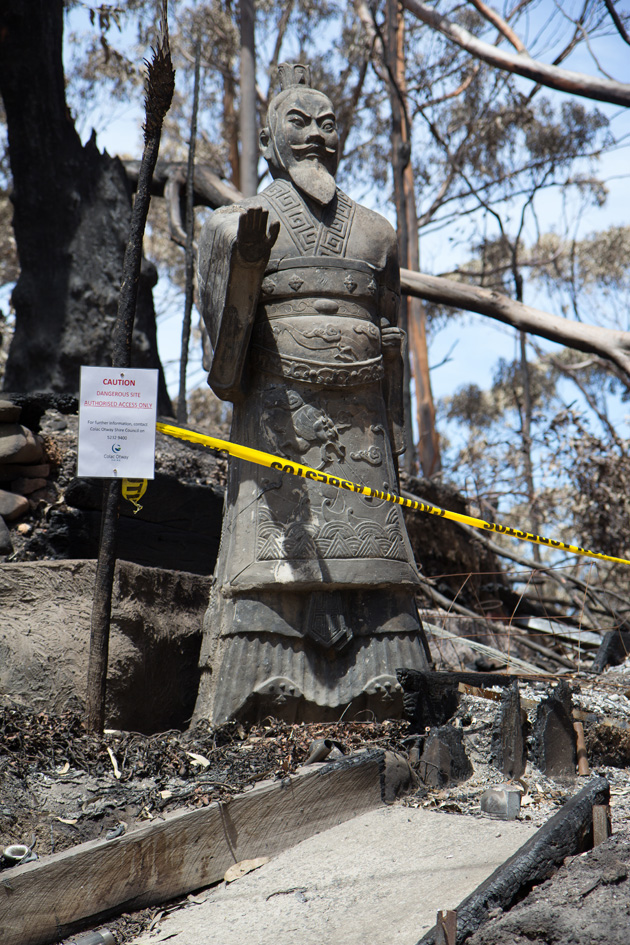
Having maintained this blog since 2016, given the experiences since then, it's reasonable to conclude that the Australian and State governments and some local governments only reinforce bushfire mythology, neglect their prevention responsibilities, fail to implement a full PPRR risk management approach to mitigating bushfire, shortcomings proven in the devastation of Wye River–Separation Creek on Christmas Day 2015 and Yarloop, WA, on 7 January 2016. And elsewhere since then.
There are groups and governments and their responsible agencies, particularly some responsible for managing public land that are either mischievously using the wildfires earlier this year to promote climate change as the reason for the fires or using it as a cover for failing to adapt to properly address fire management — see my post " "Wildfire management in Australia — how not to run a fire service", 25 January 2020.
In an endeavor to provide a forum for those with an interest a group of concerned individuals recently formed The Howitt Society .
Briefly, The Howitt Society is a group of experienced land and fire management practitioners; scientists, foresters, anthropologists, historians, and past and current stake-holders who all share one passion – caring for country. The website is our public forum on which to post information, discuss topics and stay informed on important issues regarding land management.
To my knowledge The Howitt Society is one of very few groups presenting a contrary view to those ignoring or denying the importance of fuel reduction to mitigate the effect of wildfire on social, environmental and economic values in Australia. We have a lot of catching up to do.
For those interested the Society recently launched a Facebook public group to facilitate the exchange of relevant information and ideas.
As always, I would welcome your feedback.
Note that the coloured text indicates links to further information to be clicked on.
Been a disturbing but interesting wildfire situation in Australia during the last few weeks.
Before going any further I must say that my criticism is of governments and departmental executive management and not firefighters on the ground who work their guts out, in some cases put their safety at risk and sadly some make the supreme sacrifice to protect life and property.
Plate 1
Grenfell Tower Fire, 4 June 2018
Photo: Daily Mail Australia
First, going overseas to put the subject of this posting in context, I'm drawn to the Grenfell Tower fire in London early on 14 June 2017, where at least 70 people lost their lives in the tower.
It took the London Fire Brigade a short few hours to get it's emergency response sorted out, but in that time at least 71 people lost their lives. And, the flammability of the cladding and other structural faults contributed to the development and spread of the fire. Sound familiar?
There's another fire service much closer to home in my case that failed in its response to major fires and neglected reducing the wildfire threat due to fuel accumulation in National Parks and government administered forests in the State of Victoria. Here, I'm referring to the Department of Environment, Water, Land and Planning , otherwise known as DELWP, Victoria.
Within DELWP is Forest Fire Management . Now, I'll draw a parallel with the London Fire Brigade prior to the Grenfell Tower fire, the LFB response took a short few hours to get its response act together, whereas DELWP took days, and months to make a meaningful response to some of those outbreaks of fire, fire spread and suppression difficulty growing accordingly.
Fuel in the form of flammable cladding was very largely responsible for the intensity and spread of the Grenfell Tower fire. There are materials testing procedures and building design requirements to prevent a Grenfell Tower situation.
There can be no doubt that the intensity and spread of wildfire in Victoria alone is due to buildup of fuel in forests and National Parks and the threat it presents.
Plate 2
Dwellings on the southern side of Cassidy Drive, Kennett River
Photo: John Nicholson
Plate 3
Opposite or north of the dwellings in Plate 2
Photo: John Nicholson
Plate 4
From Kennett Road upslope towards the dwellings in Plate 2
Photo: John Nicholson
Though Plates 2, 3 and 4 were photographed in July 2017 I have revisited the sites as recently as September 2019 and am confident that the fuel hazard remains.
FUEL
Referring to the fire triangle (above), in both structural fire and wildfire environments the availability of fuel is the major contributor to fire intensity and spread. For wildfire, there is really only one practical and effective treatment, reduce the fuel!
Stay tuned.
As always, I would welcome your feedback.
Note that the coloured text indicates links to further information to be clicked on.
In my previous posting on Tuesday, 12 November 2019, I expressed my views on "the meaning of life" in the context of wildfire management.
In support of my opposition to the once-size-fits-all penchant of governments and their emergency management agencies for evacuation and the consequent adverse affects it can have on people either urged of forced to evacuate there needs to be a serious refocus on the importance of the home in managing wildfire. From John O'Donohue, Irish Poet and Philosopher:
WHERE LOVE HAS LIVED
A home is not simply a building; it is the shelter around the intimacy of a life. Coming in from the outside world and its rasp of force and usage, you relax and allow yourself to be who you are. The inner walls of a home are threaded with the textures of one's soul, a subtle weave of presences. If you could see your home through the lens of the soul, you would be surprised at the beauty concealed in the memory your home holds. When you enter some homes, you sense how the memories have seeped to the surface, infusing the aura of the place and deepening the tone of its presence. Where love has lived, a house still holds the warmth. Even the poorest home feels like a nest if love and tenderness dwell there.
When I posted the previous blog this was the fire situation in north-eastern New South Wales on Friday, 8 November 2019:
Plate 1
Friday 8 November 2019
Plate 2
1500 hrs Sunday 8 December 2019
And below, enormous fires north and southwest of Sydney:
Plate 3
1500 hrs Sunday 8 December 2019
And since 8 December its become dramatically worse around Sydney, culminating in NSW Premier Gladys Berejiklian last Thursday declaring a "state of emergency".
Plate 4
0750 hrs Sunday 22 December 2019
Seems there's potential for these monsters to join in the Katoomba area
Concerning my previous discourse on the "meaning of life", not only is loss of life and property climbing, the toll now includes firefighters killed in the line duty. Then there's the threat to health on a much broader scale due to heavy smoke, particularly in the Sydney region.
How worse can it get, the smoke interfered with Big Bash cricket in Canberra last evening!!!!
To quote Professor Julius Sumner Miller, "Why is it so?" The answer is largely in the fire triangle.
And of course I'm referring to the only component that humans can control: Fuel.
If you've been following the two main themes of discussion, one view is that "climate change" is responsible for the fires, a very tenuous argument in my opinion because it does not assist with dealing with "the here and now". The other theme concerns ineffective land management i.e. lack of hazard reduction or more particularly fuel reduction burning in forests and National Parks.
Ultimately on your head Premier Berejiklian, and your head Premier Andrews for the second catastrophe in East Gippsland this year.
Plate 5
1505 hrs Sunday 22 December 2019
East Gippsland fires — how long before two or more join?
MANAGING A CRISIS
While thinking about a headline I was tempted to refer to the Prime Minister's much-derided "thoughts and prayers", but what else does he have to offer that will deal effectively with the "here and now"? What advice has the PM been offered by the so-called experts e.g. AFAC, the Bushfire and Natural Hazards CRC or at an emergency meeting of COAG?
Then for a few minutes the headline “adapt or die” — death in the broader context of the harmful effect of the fires on community physiological and psychological health, the economy and environmental values.
Concerning the call by many to declare a "national emergency", what would that entail and how does the PM do that when the States are responsible for wildfire prevention and suppression and can't even agree on how to manage water in the Murray-Darling system.
Prime Minister Morrison, it is a national emergency due to war declared on us by wildfire, with climate change adherents predicting that it will only get worse. Time for strategic leadership from the adults that provides immediate and ongoing wildfire mitigating solutions — carpe diem Prime Minister, time to kick arse and deal with a homeland security threat and not abandon us to recalcitrant State governments or an unelected activist.
Stay tuned.
As always, I would welcome your feedback.
Note that the coloured text indicates links to further information to be clicked on.
Wildfire, with so much burning here in Australia and in the USA what does the future hold?
I started preparation of this blog during a period of relative calm a few days prior to the hellish fire situation in north-eastern New South Wales on Friday, 8 November 2019, but kept being distracted by a worsening fire situation.
Plate 1
1910 hrs Friday 8 November 2019
Plate 2
1313 hrs Saturday 9 November 2019
Following wildfires across the state of Victoria in 2009 that took 173 lives — how many other lives were shortened in the aftermath of the fires, an issue I'll delve into later — the government established the 2009 Victorian Bushfires Royal Commission to investigate the circumstances of those fires and make such recommendations as considered appropriate.
Protection of human life
Of the Commission’s 67 recommendations and other writings, to me the following quote stands out:
This reference to the protection of human life appears in several other places in the Commission's report and recommendations. The land use planning element of DELWP, and elsewhere in Victoria's emergency management literature there is reference to the "primacy of life".
Considering the loss of life and peoples homes and livelihoods in the current NSW and Queensland fires how is human life affected? I hear the emergency management agencies and governments congratulating themselves that there was no loss of life or it was minimised — "officially" those unfortunates who did lose their lives will probably carry the blame for their own demise i.e. they were warned.
The meaning of life
Surely there's more to it than simply saving their skins and what they stand up in. To me there is, which brings me to my heading, "Wildfire and the meaning of life."
A home is not simply a building; it is the shelter around the intimacy of a life. Coming in from the outside world and its rasp of force and usage, you relax and allow yourself to be who you are. The inner walls of a home are threaded with the textures of one's soul, a subtle weave of presences. If you could see your home through the lens of the soul, you would be surprised at the beauty concealed in the memory your home holds. When you enter some homes, you sense how the memories have seeped to the surface, infusing the aura of the place and deepening the tone of its presence. Where love has lived, a house still holds the warmth. Even the poorest home feels like a nest if love and tenderness dwell there.
The following three photographs are of the remains of a house in Wye River a victim of the 2015 Christmas Day fire. Noting the collectables still standing, love had obviously gone into the garden and no doubt its interior. Knowing a little about the owner it was certainly more than just another house, it was a home with lots of memories.
Plate 3
Plate 4
Plate 5
A few days ago I heard NSW Premier Berejiklian mention her concern for people traumatised by the fires including words to the effect that we should look out for them and help where we can. No wonder people are traumatised worring about their homes, animals and other things near and dear, and simply fear of wildfire itself.
Plate 6
2030 hrs Tuesday 12 November 2019
Finally, referring to my earlier question "how many other lives were shortened in the aftermath of the 2009 fires" I wonder what the longer term hidden cost will be with mental health issues or suicides out of the current NSW and Queensland fires.
Evacuation is the easy option, we can and must do better at protecting human life.
Note that the coloured text indicates links to further information to be clicked on.
The following placard was carried by one of the Gippsland protestors ‒ I wonder if she realises how widely that message applies.
A galvaniser of young people to involve themselves is Greta Thunberg, a Swedish student. You may be aware that Greta declined flying to the US, instead choosing to sail across the Atlantic to New York, asserting that air travel contributes to climate change.
I've been reading of politicians and emergency services leaders describing the recent fire activity in Queensland and New South Wales as "unprecedented". As to the accuracy of this description, to me that's no excuse.
Queensland in particular, why did the emergency management agencies not see this coming? Didn't they have people monitoring the drought factor; seek advice from the Bureau of Meteorology to learn of the potential for "unprecedented" extreme fire weather conditions based climate change?
Again, the question at the end of my 7 September posting, "How then to deal with the "new normal"? Clearly thinking outside the box is required to reduce environmental, social and economic loss from bushfire across Australia, but with their reliance on going it alone and water/fire retardant bombing is that a "bridge to far"?
We have nothing to be smug about in Victoria, the public land manager DELWP has little to be proud of in meeting its responsibility for fire management ‒ prevention and suppression ‒ in Gippsland last summer. What was the otherwise avoidable damage done to the environment as a result of those fires, including harmful products of combustion released into the atmosphere?
And, Minister Lily D'Ambrosio, who has multiple portfolios involved, has since received what some may consider is a hefty pay increase. So much for ministerial responsibility and accountability.
Finally, the Emergency Management Commissioner has some significant challenges if social, economic and environmental loss is to be substantially reduced in a climate increasingly conducive to the outbreak and spread of bushfire in Victoria.
Note that the coloured text indicates links to further information to be clicked on.
No doubt the social, economic and environmental losses accruing from these fires and fires yet to occur before the wildfire season or summer is over will be enormous and we've not yet seen the contribution Victoria is likely to add to the losses.
I continue to see governments and others claiming that climate change i.e. global warming is responsible for these fires, but not helping the broader community better prepare to withstand wildfire and its loss potential. By this I mean the forcing or encouraging people to leave their homes to agency firefighters and run the risk that they won't be defended due to lack of firefighters available for this task. I wonder how many of the homes lost will have succumbed to ember attack.
How then to deal with the "new normal"?
Note that the coloured text indicates links to further information to be clicked on.
Referring particularly to Victoria, though it's the situation elsewhere in Australia, loss is increasing daily with the current spate of fires.
While I could rant about the failure to bring lightning strikes under control much earlier, this story in today's The Age, is worthy of wide consideration, "We are not doing nearly enough to prevent the impacts of bushfire", by Kate Cotter, CEO Bushfire Building Council of Australia.
The failure by those responsible for the well-being of us and the natural environment includes the failure to manage fuel levels in our forests and parks, resulting in heavy fuel loads that are a major contributor to fire intensity and consequent suppression difficulty.
What are the root causes of theses losses? I've written about them in previous postings and they involve non-performing governments and their fire and emergency and land management agencies and local government. And then there's the firefighting industry: air attack to mention one beneficiary. And the insurance industry is worthy of a mention, too. But more about the insurance industry later.